For NREMT purposes:
This course presents an ALS-level medical case and focuses on cardiology and respiratory systems.
6 CEH (AEMT/Paramedic)
CAPCE-approved
$149/6-months access
Self-directed continuing education.
Complete at your own pace.
View real emergency cases
Train in real anatomy
More ↓
What EMS professionals say:
This CE activity is accredited by the Commission on Accreditation for Pre-Hospital Continuing Education (CAPCE) for
6 AEMT CEH or 6 Paramedic CEH.
More ↓
Already registered? Please login.
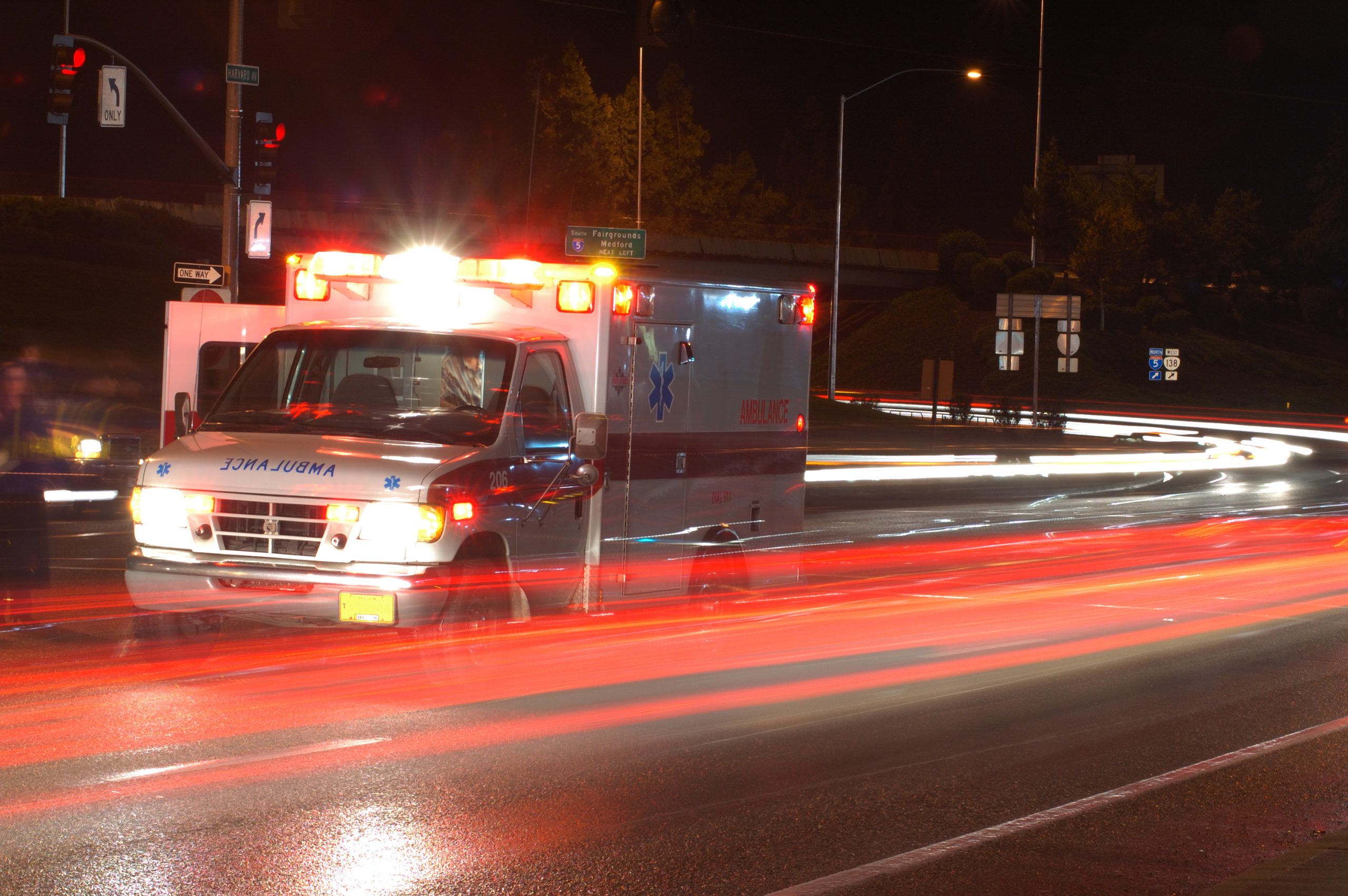
Simulate a field experience.
The patient is real.
In this course you’ll …
- Follow and apply your own clinical assessment to a real EMS case
- Review and assess real EMS records
- View the patient’s actual external exam
- Assess clinical data and decisions from the field
- Check your clinical thinking against actual changes inside the body
- Review the patient’s autopsy findings
- See if you made the correct clinical decisions based on the clinical data
- Strengthen your evidence-based assessment of the body
- Learn from real, video-based human anatomy and pathology
Questions? info@autopsy.online
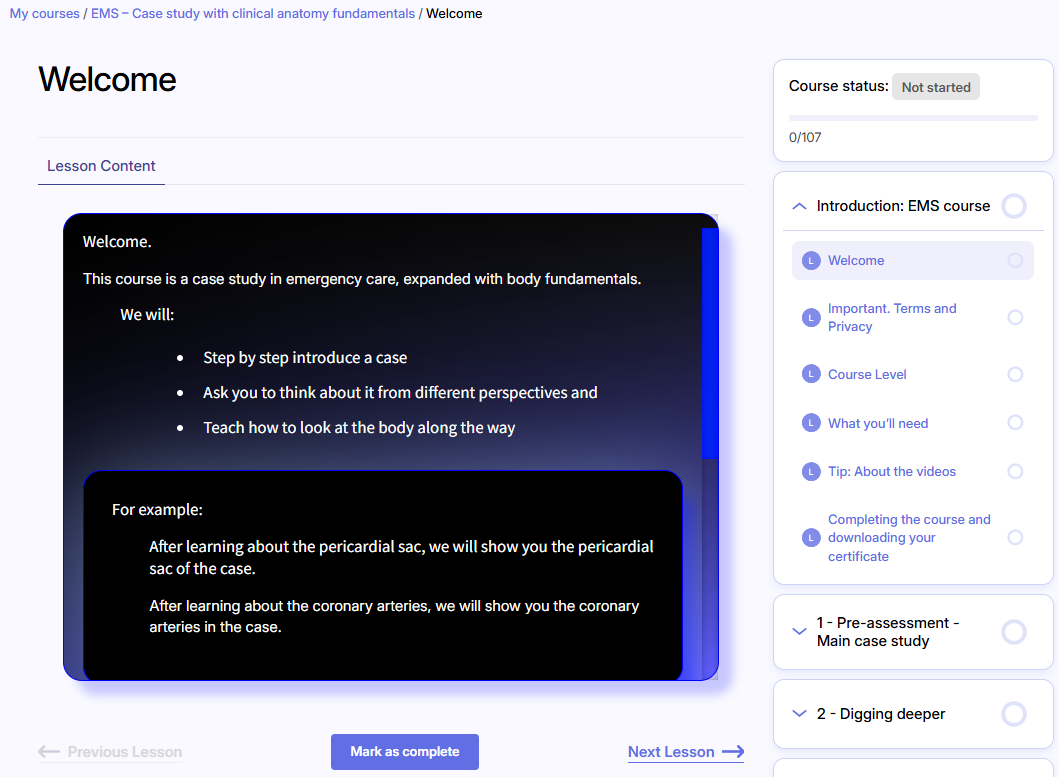
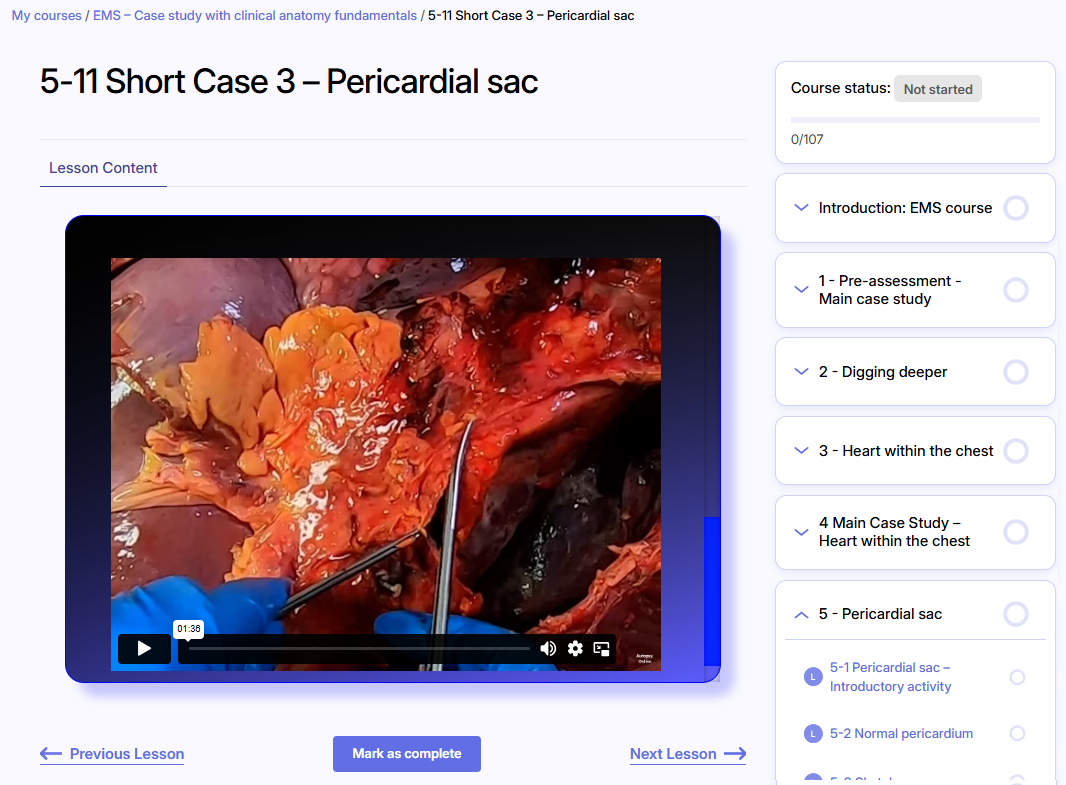
Preview
(Desktop recommended)


End of preview
Course Outline
Introduction
Important – Terms and Privacy
How this course fits in with your career
Course level
What you’ll need
Tip: About the videos
Completing the course and downloading your certificate.
1 – Pre-assessment – Main Case Study
1-2 Preliminary data – 1
1-3 Preliminary data – 2
1-4 Preliminary data – 3
1-5 Preliminary data – 4
2 – Digging deeper
2-2 Additional history – 1
2-3 Additional history – 2
2-4 Additional history – 3
2-5 Additional history – 4
2-6 Additional history – 6
2-7 New considerations
2-8 Get ready to look inside the body
3 -Heart within the chest
3-2 Heart within the chest
3-3 Sketch
3-4 Short Case – 1
3-5 Short Case – 1 – sketch
3-6 Short Case – 2
3-7 Short Case – 2 – sketch
3-8 Discussion and Review
4 – Main Case Study – Heart within the chest
4-2 Main Case Study – Sketch
5 – Pericardial sac
5-2 Normal pericardium
5-3 Sketch
5-4 Short Case – introduction – 1
5-5 Short Case – introduction – 2
5-6 Short Case – introduction – 3
5-7 Short Case 1 – Pericardial sac
5-8 Short Case 1 – Your assessment
5-9 Short Case 2 – Pericardial sac
5-10 Short Case 2 – Your assessment
5-11 Short Case 3 – Pericardial sac
5-12 Short Case 3 – Your assessment
5-13 Short Case 4 – Pericardial sac
5-14 Short Case 4 – Your assessment
5-15 Short Case 5 – Pericardial sac
5-16 Short Case 5 – Assessment
5-17 Short Case 6 – Pericardial sac
5-18 Short Case 6 – Assessment
5-19 Discussion
5-20 Review
6 – Main Case Study – Pericardial sac
6-2 Your Assessment
6-3 Your Analysis
6-4 Discussion
7 – Heart connections
7-2 Make your model
7-3 Aorta and Pulmonary Artery – inside the pericardial sac
7-4 Superior vena cava – inside the pericardial sac
7-5 Inferior vena cava – inside the pericardial sac
7-6 Pulmonary veins
7-7 Tour of the heart connections – explanted heart
7-8 Review your model
8 – Main Case Study – Heart connections
9 – Heart external anatomy
9-2 Anatomy pin identification – activity
10 – Main Case Study – Heart external anatomy
11 – Coronary arteries
11-2 Coronary arteries – basic famework
11-3 Coronary arteries – in detail
11-4 Lab 1 – Heart orientation
11-5 Lab 2 – Coronary artery exposure
11-6 Lab 3 – Coronary artery exposure
11-7 Lab 4 – Coronary artery removal
11-8 Lab 5 – Coronary artery removal
11-9 Lab 6 – Coronary artery removal
11-10 Lab 7 – Coronary artery plaque assessment
11-11 Summary video
11-12 Short Case 1 – basic vessels
11-13 Short Case 2 – coronary artery plaque
11-14 Short case 3 – coronary arteries
12 – Main Case Study – Coronary arteries
12-2 Discussion
13 – Heart internal anatomy
13-2 Right atrium
13-3 Valves
13-4 Fetal heart anatomy – introduction
13-5 Ductus arteriosus
13-6 Foramen ovale
14 – Main Case Study – Internal anatomy
15 – Additional vessels
15-2 Branches of the aortic arch
15-3 Iliofemoral vessels
15-4 Short Case 1 – Additional vessels – 1
15-5 Short Case 1 – Additional vessels – 2
16 – Main Case Study – Central circulation
16-2 Main Case Studey – Additional clinical information
17 – Respiratory/Airway
17-2 Anatomy pins – 1
17-3 Anatomy pins – 2
17-4 Anatomy pins – 3
18 – Airway – Main case study
18-2 Larynx
18-3 Anatomy pins
18-4 Discussion
19 – Discussion
19-2 Final thoughts
20 – Accessing the Assessment
20-2 Tip: How do I check if I missed marking any lessons “Complete”?
20-3 Bibliography
EMS Assessment
Required information: CAPCE Accreditation Management System (AMS)
Assessment – EMS Case Study with Clinical Anatomy Fundamentals
Course evaluation